Butrint: A Half-Day Among Twenty-Five Centuries
3 August 20263 min read
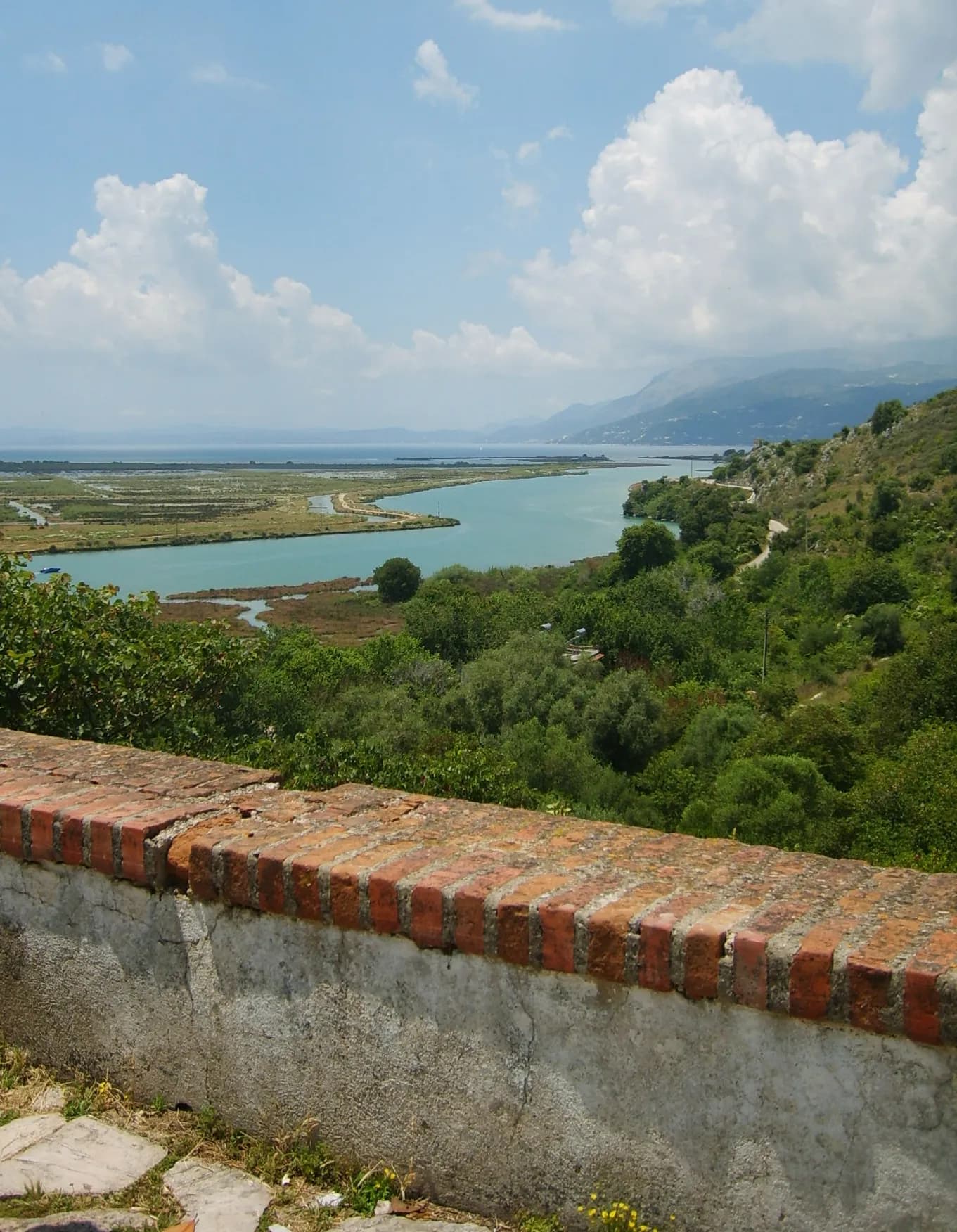
Some ruins ask you to imagine a great deal. Butrint asks less. The stone here is legible: a theatre where you can count the rows, a font where you can still trace the pattern in the floor, a fortress wall that has kept its edges. The site sits about twenty kilometres south of Saranda, on a low peninsula between a freshwater lagoon and the channel that runs down to the sea, and much of it lies under old oak and laurel, so the walk stays cool even when the coast is glaring.
What makes Butrint unusual is not a single monument but the stacking. Nearly every occupying culture of the Mediterranean passed through and left something behind, one layer resting on the last. You are not looking at one city. You are looking at the same place rebuilt, again and again, for roughly twenty-five centuries.
The city, era by era
The Greeks arrived first in any organised sense, and the theatre carved into the hillside is the clearest thing they left. It faces a small sanctuary and still holds its shape well enough that you read it instantly as a place for gathering. Above it the ground climbs toward the acropolis, where the later museum now stands.
Rome expanded the town into something grander, with the usual civic apparatus, and the outlines of that period are visible across the flat ground below the theatre. Later, in the Byzantine centuries, Butrint became a Christian centre. Its baptistery is the piece most people remember: a wide circular font ringed by columns, its floor laid with mosaics of animals and geometric patterns. Those mosaics are usually kept covered under a protective layer of sand or gravel, so do not expect to see them exposed — this is deliberate conservation, not neglect.
The great basilica nearby shows the same era at architectural scale. Then come the Venetians, who fortified the approaches and built the tower that now houses the museum, and finally the Ottomans, whose presence closes out the long sequence. Each group used what the previous one had built. That reuse is the through-line of the whole site.
Walking it well
Butrint is compact and works as a loop. A clearly marked path threads the main monuments — theatre, baptistery, basilica, the walls and gates — and climbs to the acropolis museum, which is worth the short effort for both the collection and the view over the lagoon. An unhurried circuit runs somewhere between an hour and a half and two and a half hours, depending on how long you linger and how often you stop to read the panels.
Wear proper shoes: the paths are uneven stone and old paving, occasionally slick in shade after rain. Bring water. Much of the route is shaded, which is a genuine mercy in summer, but the open stretches near the water are exposed. Check current opening hours and the entry fee through the park's official channels before you set out, as both change seasonally.
Practical info
Getting there from Saranda is simple: it is the end of the coastal road heading south, about twenty kilometres, and driving takes roughly thirty to forty minutes. In summer a local bus runs the route several times a day; a taxi is straightforward if you would rather not drive. The road itself is pleasant, tracing the lagoon for the final stretch.
Allow a half-day if you want to do it properly — the walk plus travel, without rushing. Go early in the morning or in the last hours before closing, when the light is kinder and the tour groups thin out. Spring and autumn are ideal: mild, green, and quiet. Midsummer is very hot by late morning, so if you come in July or August, be at the gate soon after opening and treat the afternoon as time by the water instead.