The Blue Eye: Albania's Bottomless Spring
27 July 20262 min read
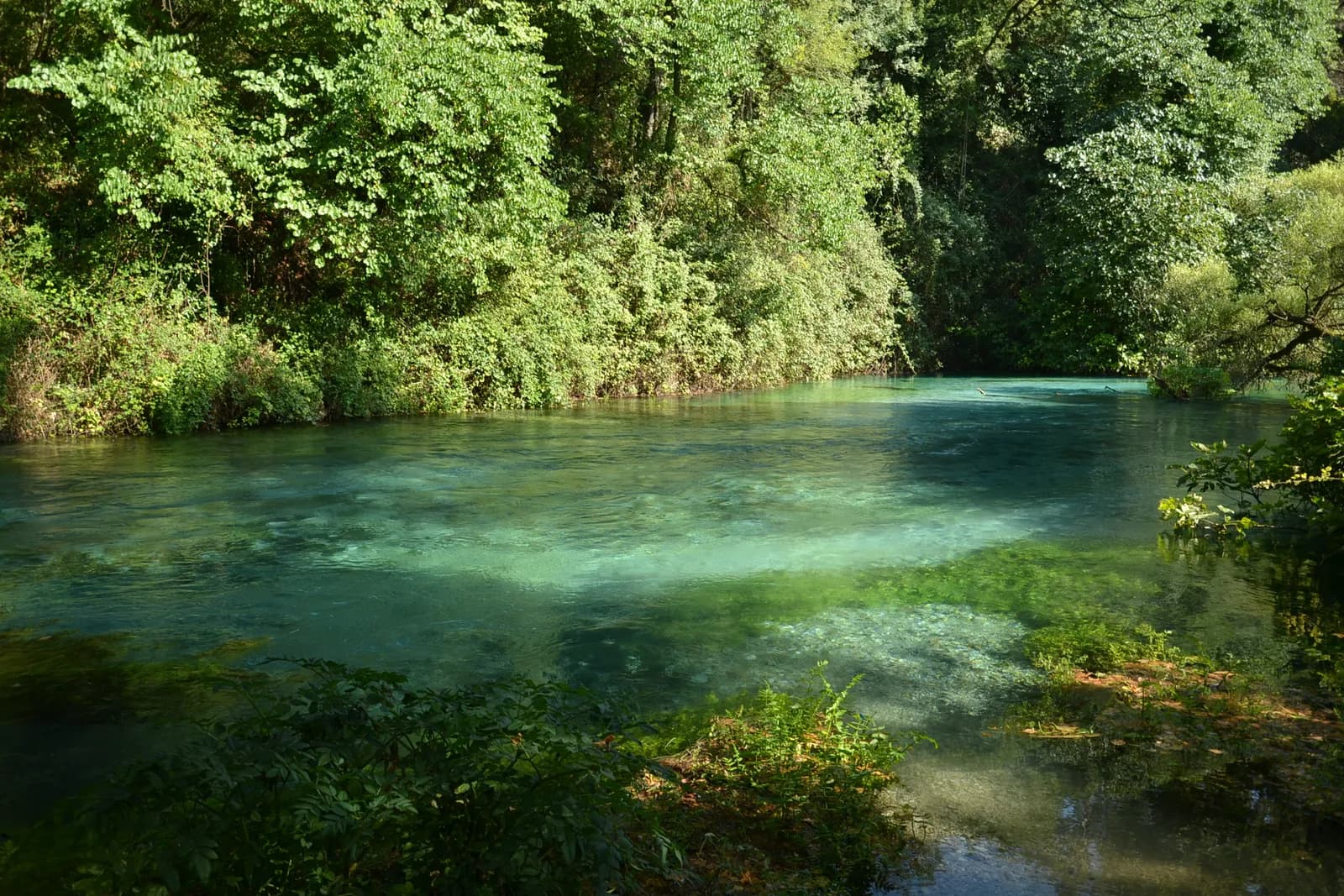
Some places live up to their photographs, and some do not. The Blue Eye — Syri i Kaltër in Albanian — belongs firmly to the first group. It sits in the hills northeast of Saranda, a natural spring where cold groundwater rises through a deep vertical shaft in the limestone and spreads into a pool of impossibly vivid blue.
It is close enough to reach in a morning and quiet enough, at the right hour, to feel like a small discovery. That timing is the whole trick, and we will come back to it.
Why the water is that blue
The spring is a karst phenomenon. Rain and snowmelt sink into the surrounding limestone mountains, travel underground, and surface here under pressure through a shaft whose true depth has never been fully measured — divers have descended dozens of metres without reaching the bottom, which is why locals call it bottomless.
Because the water is so cold, clean, and constantly moving, it scatters light in a way that produces that saturated cobalt heart fading to pale turquoise at the edges. The spring feeds the Bistricë river, which runs down toward the coast. Stand at the railing above the shaft and you can watch the current visibly welling up from below.
What a visit actually looks like
From the car park it is a short, easy walk — partly a boardwalk — through shade to the spring itself. A viewing platform sits directly over the deep blue eye, and there are calmer, shallower stretches of the river nearby.
Swimming is cold year-round and is officially restricted at times, both to protect the site and because the current near the shaft is stronger than it looks. Treat any dip as a brief, bracing one rather than the reason you came. The reason you came is the colour, and the pine-shaded quiet around it.
Practical info
Getting there from Saranda is straightforward: it lies roughly 20–25 km northeast, heading inland toward Muzinë, about 30–45 minutes by car. A taxi or rental car is the simplest option; the final stretch is a short unpaved road to the parking area. A small entrance and parking fee usually applies — check the current amount and opening hours locally, as they change with the season.
Timing matters more than anything else. In July and August the site fills up around midday, and tour groups can crowd the narrow platform. Come early in the morning, close to opening, or visit in the shoulder season — May, June, September, October — when the light is soft, the air is cooler, and you may have the railing almost to yourself. Bring water and a light layer; even in high summer the shaded spring stays noticeably cool.